




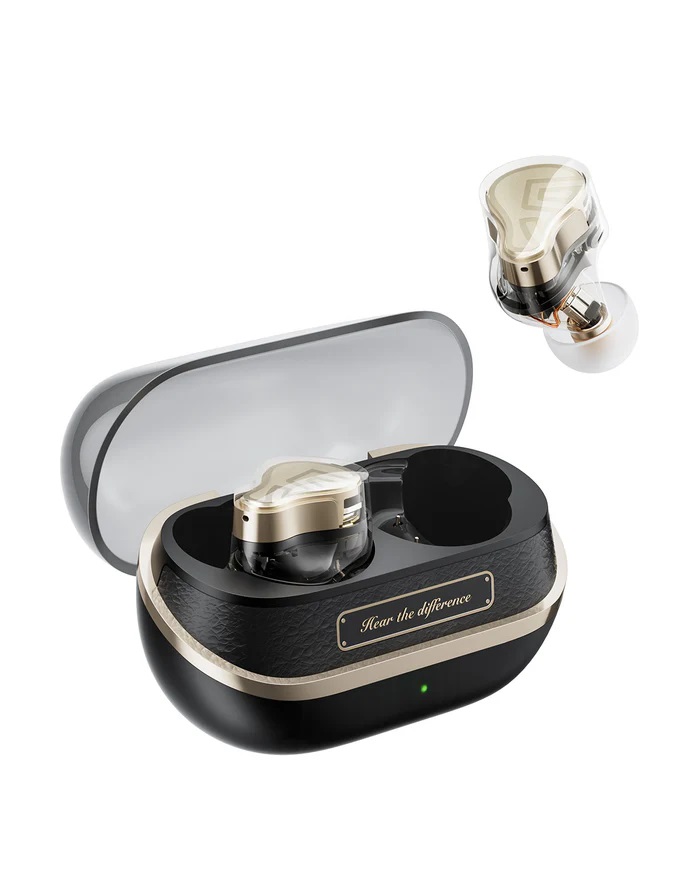
SOUNDPEATS is a well established (16 years) manufacturer of inexpensive quality Bluetooth headphones with an eye towards versatility, reliability, value, and precision construction. They have now decided to take a stab at high-fidelity with their first multi-driver offering, the SOUNDPEATS H3 (Triple-Driver Hybrid / LDAC) TWS IEM. A quick look at the product told me this is something that might interest Headphone.Guru readers, so a review sample was arranged.
SOUNDPEATS H3 (Triple-Driver Hybrid / LDAC) TWS IEM
Far from an entry-level piece that its price would indicate, the SOUNDPEATS H3 (Triple-Driver Hybrid / LDAC) TWS IEM offers a Flagship Sound Architecture of 2 balanced armature drivers and a 12mm dynamic driver, with a Qualcomm® QCC3091 with Snapdragon Sound™, supporting LDAC and aptX Lossless which Supports LDAC, aptX Lossless, and Snapdragon Sound — up to 1.2Mbps Ultra-High Bitrate and is Hi-Res Certified. AI-powered ANC with Six built-in microphones, AI noise reduction, and cVc™ 8.0 delivers up to 55dB noise reduction across 4 modes (Adaptive, Indoor, Outdoor, Traffic). The H3 is crafted from 6 high-quality materials with over 16 manufacturing steps, featuring an anodized aluminum nozzle and a crystal-clear housing revealing the refined inner structure, and is IPX5 Water Resistance. Battery life for the H3 is listed as up to 7 hours battery life per charge and 37 hours with case, plus 2 hours from a 10-minute charge.
As a bonus, the H3 offers App-Driven Audio Tuning, allowing for adjustable sound profiles in real time using the 9-band EQ available in the PeatsAudio app.
Living with the SOUNDPEATS H3 (Triple-Driver Hybrid / LDAC) TWS IEM
I began my listening tests of the SOUNDPEATS H3 (Triple-Driver Hybrid / LDAC) TWS IEM by just listening . . ; to everything, podcasts, music, YouTube, whatever I was currently doing. Unfortunately, it was not easy to determine battery life during burn-in, so I decided to just run them until they stopped. This turned out to be about four hours at about two-thirds volume, or what I consider a long-term listenable volume. This seemed a reasonable battery life given the maximum battery life at a minimal volume is seven hours. This means you should get about 22 hours out of a fully charged case or 26 if you assume the H3s were in the case while it was charged, which seems like plenty for most uses.

First up for musical tests was Jill Scott’s new album “To Whom This May Concern” (24-bit/48kHz – Qobuz). The tonal balance for this contemporary R&B recording was cheerful upper-midrange-centric, with decent bottom end. This offered up a definite level of clarity to the vocals without being overly harsh.

Next on the bill was “Prokofiev: Romeo and Juliet, Op. 64” (24-bit/96kHz – Qobuz) performed by the Los Angeles Philharmonic, Gustavo Dudamel conducting. The timbre of the instruments was excellent for a product in this category, though I did find myself running the H3 at full volume to achieve Disney Hall sound levels and dynamics. The soundstage was of good size, while the image drifted a little.

Moving onto “Wabi Sabi” (24-bit/48kHz – Qobuz) by Sotomayor, Pahua, and Tonga Conga, an exploration into Latin Electronica. The steel drums came across crisp and realistic and appeared to be the one acoustical aspect of the computerized wall of sound. For this piece, the soundstage appeared even larger, though one could hear the ringing of the reverb in the background.

Charli XCX with vocals by John Cale presented an amazing mixture of natural and electronic sounds in a massive soundstage with “Wuthering Heights” (24-bit/48kHz – Qobuz).

At this point, I installed the PeatsAudio app and played with the self calibration (“Adaptive EQ”), but after listening to Melissa Aldana’s “Filin” (24-bit/96kHz – Qobuz) found their “HIFI” setting to be the most appealing and natural sounding.
The PeatsAudio app allowed me to play with the Active Noise Cancelling. There are actually four settings, which is unusual; “Transparent” (pass through), “Normal”, “Noise Cancelling”-“Adaptive Noise Cancellation”, and “Noise Cancelling”-“Indoor Noise Cancellation”. I wasn’t able to hear a difference between the Adaptive and Indoor settings, but I also didn’t go wandering around outside to test it. The ANC significantly reduced simulated aircraft noise (via YouTube), and the Transparent improved external voice clarity, but most impressive was the tonal balance of the music remained constant in all modes.
I followed this up with a few phone calls, and the H3 performed admirably in this role. I also did some experiments with range which passed through several walls without any loss of signal.
As final tests, I turned to my regular playlist, which is available on Qobuz as https://open.qobuz.com/playlist/10673532 to compare using songs I am infinitely familiar with. “Can-Utility and the Coastliners” (“Foxtrot” – Genesis – 16-bit/44.1kHz-Qobuz) was rendered with fantastic bottom end, the tonal balance was fairly neutral with a slight emphasis to the jangle of the guitars. The soundstage was large but intimate, the Mellotron a bit electronic.

The piano for “Dance Anthem Of The 80’s (Live In London)” (“Live in London” – Regina Spektor – 16-bit/44.1kHz-Qobuz) felt a little amplified, which only makes sense since it is a live recording, but the soundstage was massive, though again very close in depth.
Conclusions on the SOUNDPEATS H3 (Triple-Driver Hybrid / LDAC) TWS IEM
You don’t really expect a lot from a $130 TWS IEM, but the SOUNDPEATS H3 (Triple-Driver Hybrid / LDAC) TWS IEM exceeded not only expectations, but the best of what I’ve heard in this category. They were louder with my phone than with my computer, but they offered excellent tonal balance and bass that deserves mention without being boomy like most under $200 offerings. They sounded like a pair of IEMs rather than like a pair of earbuds. The ANC worked well, and phone calls were clear. They did appear to be a little more musical with the higher bit rate recordings, and the PeatsAudio app helped in this concern. I should point out that the EQ changes are subtle for the most part, though I believe this to be for the better. The H3 is a sure fit for a daily use TWS IEM, pleasant with most genres, versatile, comfortable for long-term use, a good choice for on-the-go use.
SOUNDPEATS deserves a solid thumbs up for a solid product.
Price: $129.99
Manufacturer’s Website: https://soundpeats.com/products/soundpeats-h3
- Core Specs
Bluetooth: V5.4
Profiles: HSP/ HFP/ A2DP/ AVRCP
Chipset: QCC3091
Supported Bluetooth Codec: SBC/AAC/LDAC/aptX/aptX Adaptive/aptX Lossless
Note: LDAC are disabled by default. Enable via the PeatsAudio app.
- Battery
Battery Capacity: 35*2 mAH (Earbuds) 400mAH (Case)
Charging Time: 1H (Earbuds)2H(Case)
10-Min Fast Charge = 2H
Charging Port: Type-C
Total Playtime: 37 hours
- What’s in the Box
SOUNDPEATS H3
Charging Case
Ear Tips (XS/S/M/L/XL) *5 Pairs
Type-C Charging Cable
User Manual
SOUNDPEATS Stickers *1 - Package
Single Earbud Weight: 6g
Charging Case with Earbuds: 53g
Control Type: Touch
Waterproof Rating: IPX5

Want to join discussion?
Feel free to contribute!